Every facility that runs more than a handful of calls for expertise faces the same quiet problem. The expert who delivered an excellent assignment last year exists somewhere in the record: a CV attached to an email, a name in a spreadsheet, a paper file in a cabinet. When a new call opens, the search begins again almost from scratch. The expertise is real. The institution's knowledge of it has evaporated.
A reusable roster solves this. It is a structured, maintained, connected record of expertise that compounds in value with every assignment run.
What makes a profile reusable
A one-off CV is designed to be read. A reusable profile is designed to be searched, compared, filtered and updated. The difference is structural.
Practically, this means capturing fields consistently rather than free-form: education and qualifications, fields of expertise (mapped to a controlled vocabulary, not free text), language competencies, employment history, references, and, critically, the assignments the expert has completed within the facility itself, with the working and mission days associated to each.
A profile linked to actual delivery history shows what an expert has done, for whom, and how it was assessed. A CV shows only what they claim to offer.
The problem with rebuilding each cycle
Facilities that manage their rosters in spreadsheets often rebuild them, or substantially refresh them, at the start of each call. The spreadsheet from the last cycle may be out of date, may never have captured the right fields, or may simply be trusted so little that no one reaches for it.
The cost is higher than it appears. The time spent re-sourcing experts who were already in the system (reaching back to them, collecting CVs again, reconstructing availability) is real work that adds no value. Worse, the facility loses the institutional knowledge accumulated across assignments: who performed well, who was available and flexible, who should be considered first for the next similar call.
When that knowledge lives only in the heads of the staff who ran the previous cycle, it leaves when they do.
What a connected roster makes possible
When the roster is a structured database connected to the facility's operational records, opening a call for expertise becomes a search.
- You publish a call and the roster responds, because subscribed experts receive notifications of open assignments matching their profile.
- Applications come in against defined fields, matched to the profile data you already hold, so you are comparing like with like from the first review.
- When a candidate is selected, their profile updates automatically with the assignment, the working days and, eventually, the performance evaluation.
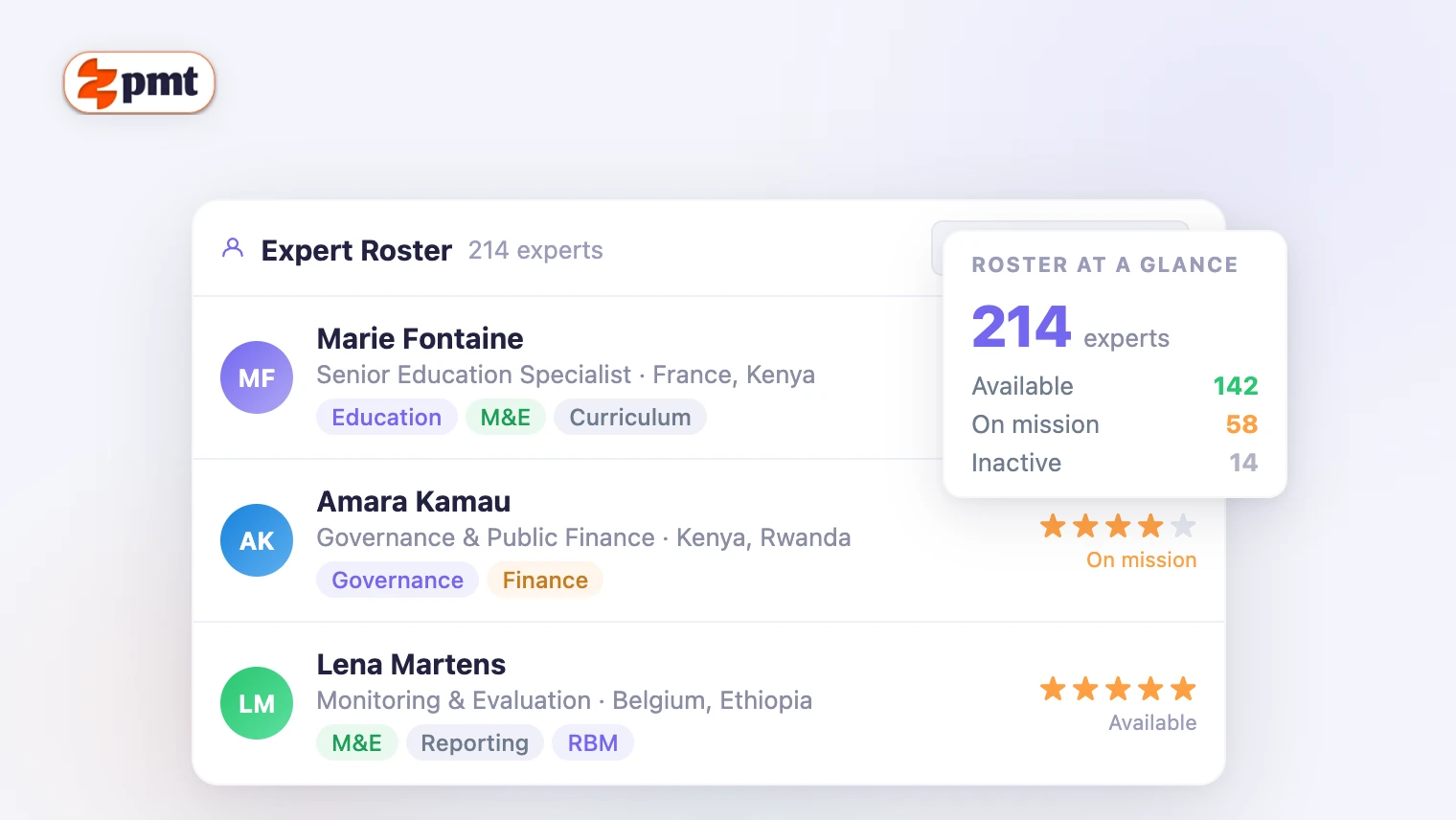
The facility's knowledge of its expert community compounds with every cycle.
The bottom line
The expert roster holds accumulated knowledge of who can do what, at what quality, under what conditions. That knowledge only compounds if the roster is structured, maintained and connected to delivery. In a spreadsheet it evaporates between cycles. As a connected database it supports every future call, with each one running faster and better than the last.