Technical assistance is a data business. A facility holds detailed personal records on hundreds of experts (education, employment history, competencies, languages, references), information about partner institutions and government bodies, their priorities and their requests, and the decision trail for how public money was allocated. This is the kind of data that regulation exists to protect.
For a public-sector operations platform, governance is a precondition for being trusted with the work.
Personal data by the bucketful
The expert roster alone is a substantial store of personal data under the GDPR. A reusable expert profile is valuable precisely because it is rich, but rich profiles are personal data, and personal data carries obligations: lawful basis for processing, data minimisation, retention limits, the right of access, the right to erasure.
A facility managing this in scattered spreadsheets and shared drives is exposed, not just inefficient. Where does a given expert's data live? Who can see it? How is a deletion request honoured across a dozen files? These are questions a compliant system answers by design and an ad-hoc setup cannot answer at all.
What European hosting means in practice
Hosting location matters for cooperation data for reasons that go beyond preference:
- Legal certainty. Data held within the EU sits under a single, well-understood regulatory regime. There is no ambiguity about which framework applies or how cross-border transfer rules bite.
- Institutional requirement. Many EU-funded programmes and public institutions have explicit requirements about where their data may reside. "100% European-hosted" is often a condition of doing business, not a nice-to-have.
- Trust. When you ask an expert or a partner institution to entrust you with their information, being able to say plainly where it lives and under what law is part of earning that trust.
Governance as a by-product of good structure
The reassuring thing about governance is that, done properly, most of it falls out of well-structured operations rather than being a separate burden.
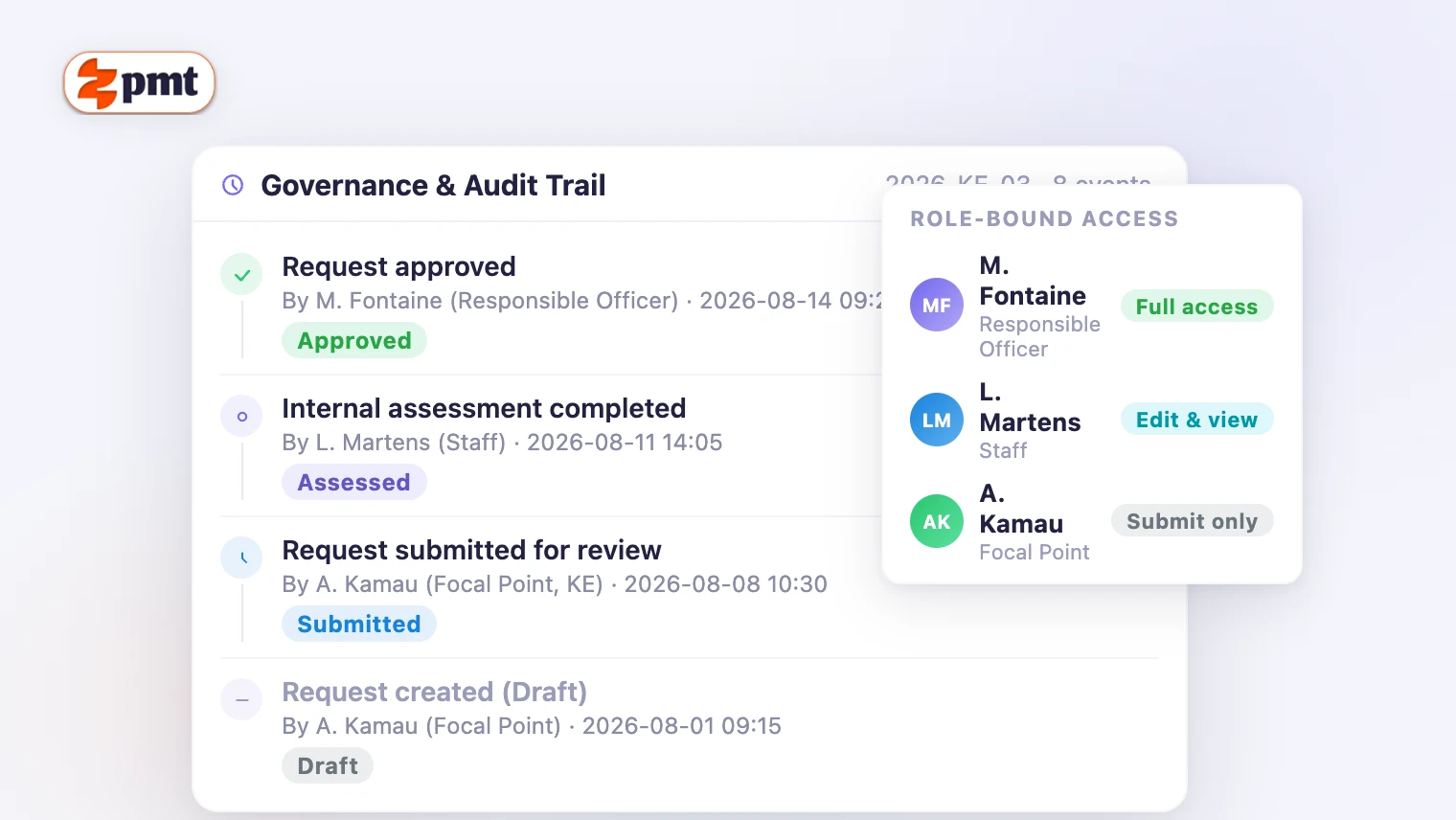
- Role-based access means people see what their role requires and no more, serving both as a security control and a data-minimisation measure.
- Structured audit logs record who did what and when as a natural consequence of every action being an entry in the system.
- Version control on documents means you always know which version is authoritative and can reconstruct the history of any file.
- Data consistency safeguards keep the single source of truth actually single.
Notice that every one of these is also just good operational practice. The facility that runs cleanly is, almost by definition, the facility that is easier to keep compliant.
Audit-ready by design
The phrase to aim for is audit-ready by design. It means that when an auditor, a funder or a data subject asks a hard question (who approved this, who accessed that, where does this figure come from, delete my data) the answer is already in the system, produced as output rather than assembled under pressure.
The bottom line
Cooperation data is sensitive by nature, and the institutions that generate it are right to be careful with it. European hosting, GDPR compliance, role-based access and audit trails are the ground on which a facility earns the right to hold the data in the first place. Handled well, they are the natural result of running operations properly.