A Technical Assistance Facility spanning multiple countries is a different operational challenge from a single-country one. Requests come from institutions under different regulatory contexts. Experts operate across jurisdictions. Funding may flow from multiple sources, each with its own reporting requirements. The programme management team is expected to give a coherent account of all of it, simultaneously, on demand.
Most facilities at this scale reach the same conclusion: the data was never in one place and was never designed to be. The effort required to assemble a consolidated picture is itself a significant programme cost that produces nothing for the beneficiaries.
What changes at multi-country scale
When a facility spans one country, the data management problem is manageable, if not elegant. The files are in a shared drive, the team is small enough that everyone knows where things are, and the reporting exercise, painful as it is, can be done in a room with the same four people.
When the facility spans six countries with five partner institutions each, the same approach breaks down. Every country team develops its own way of tracking requests, activities and expert assignments. Each partner institution submits data in whatever format it finds natural. The shared drive becomes six shared drives, none organised the same way. When programme management needs consolidated figures for a quarterly report, the answer is a two-week email campaign.
The consolidation effort does not scale. It grows faster than the portfolio.
The shadow tracker problem
The natural response to this fragmentation is the creation of shadow trackers: master spreadsheets maintained at programme level, into which the data from country-level sources is periodically transferred, normalised and validated. Facilities with multi-country portfolios are almost universally running them.
Shadow trackers work in the sense that reports get produced and donors receive figures. The weakness is that they are always out of date. The figures in a shadow tracker are current only as of the last transfer. The gap between that update and today is precisely where discrepancies accumulate.
What the data model has to support
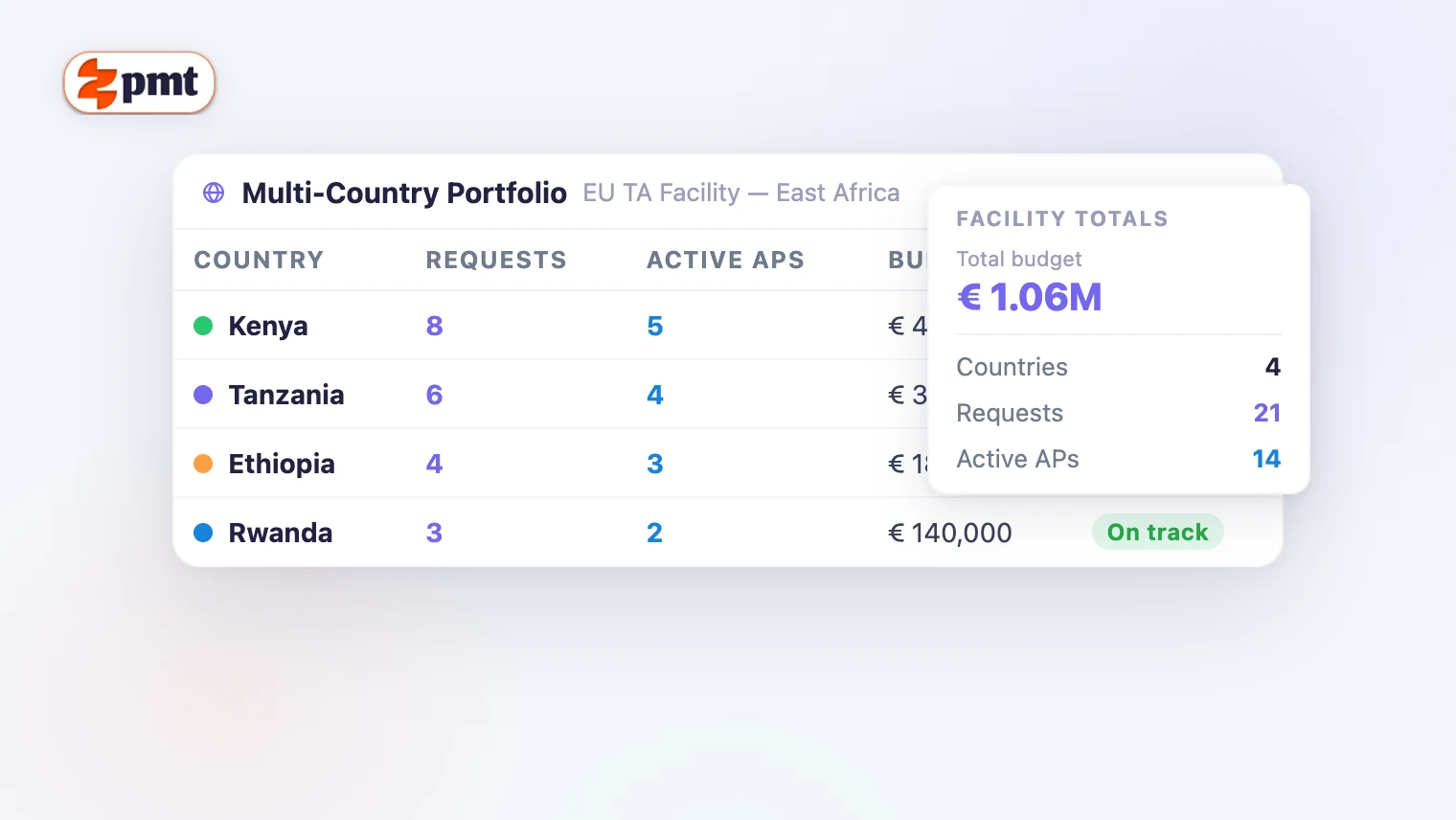
A portfolio view is a property of the data model, not a feature layered on top of a single-country system. To run a genuine portfolio view, one that reflects the actual state of all activities across all countries without manual consolidation, the system has to capture data at the right level of granularity from the outset.
That means: requests tagged to the requesting institution and country, activities tagged to the partner and funding source they sit under, expert assignments tagged to the activity, working and mission days recorded at assignment level, and results linked to the indicators of the specific funding source that required them.
When those connections exist in the data, a portfolio view is a query. When they do not exist, it is a project.
The bottom line
Multi-country scale is achievable when the data model is right. When every record enters the system with the context it needs (institution, country, partner, funding source, activity), consolidated reporting is automatic. When that context is missing at entry and has to be reconstructed later, scale becomes a management burden rather than a programme asset. Building the portfolio view is the reason the data structure has to be right from the start.