
Ask anyone who has managed an EU-funded programme what they dread most, and reporting season will be near the top of the list. The story is rarely hard to tell; the work usually speaks for itself. The problem is assembling the report: pulling figures from spreadsheets, chasing partners for updates, reconciling numbers that should match but do not, and formatting everything into the shape the funder expects.
Whether it has to be this way comes down to a single structural choice: whether your reporting draws from live operational data, or from a parallel record maintained by hand.
Results-based management, briefly
Results-based management (RBM) is the discipline of managing a programme by the results it produces rather than the activities it performs. Instead of reporting "we ran twelve workshops," you report against indicators: what changed, by how much, for whom, and against what baseline and target.
The EU peer-to-peer and results-based frameworks push in exactly this direction. They want to see outcomes, disaggregated and traceable, connected to the activities that produced them. That keeps programmes honest about impact, but it also raises the bar for reporting: you can no longer summarise activity from memory and have to trace results to their source.
Why the manual model fails at RBM
When indicators live in a reporting spreadsheet that is separate from where the work actually happens, three things go wrong:
- Lag. The indicator record is only as current as the last time someone updated it, which is usually just before a report is due. In between, no one really knows where the programme stands.
- Reconciliation. The same figure exists in two places (the operational tracker and the reporting sheet) and they drift apart. Reporting season becomes a hunt for which number is right.
- No audit trail. When a funder asks where a figure comes from, the honest answer is often "someone typed it in." That is not the traceability RBM demands.
Connecting indicators to live data
The alternative is to connect indicators directly to the operational data that already exists in the system. When a team updates a task, logs a mission day, or marks an activity complete, the indicator moves with it. The report becomes a view of the live state of the programme, not a separate document maintained in parallel.
That single change transforms reporting in three ways:
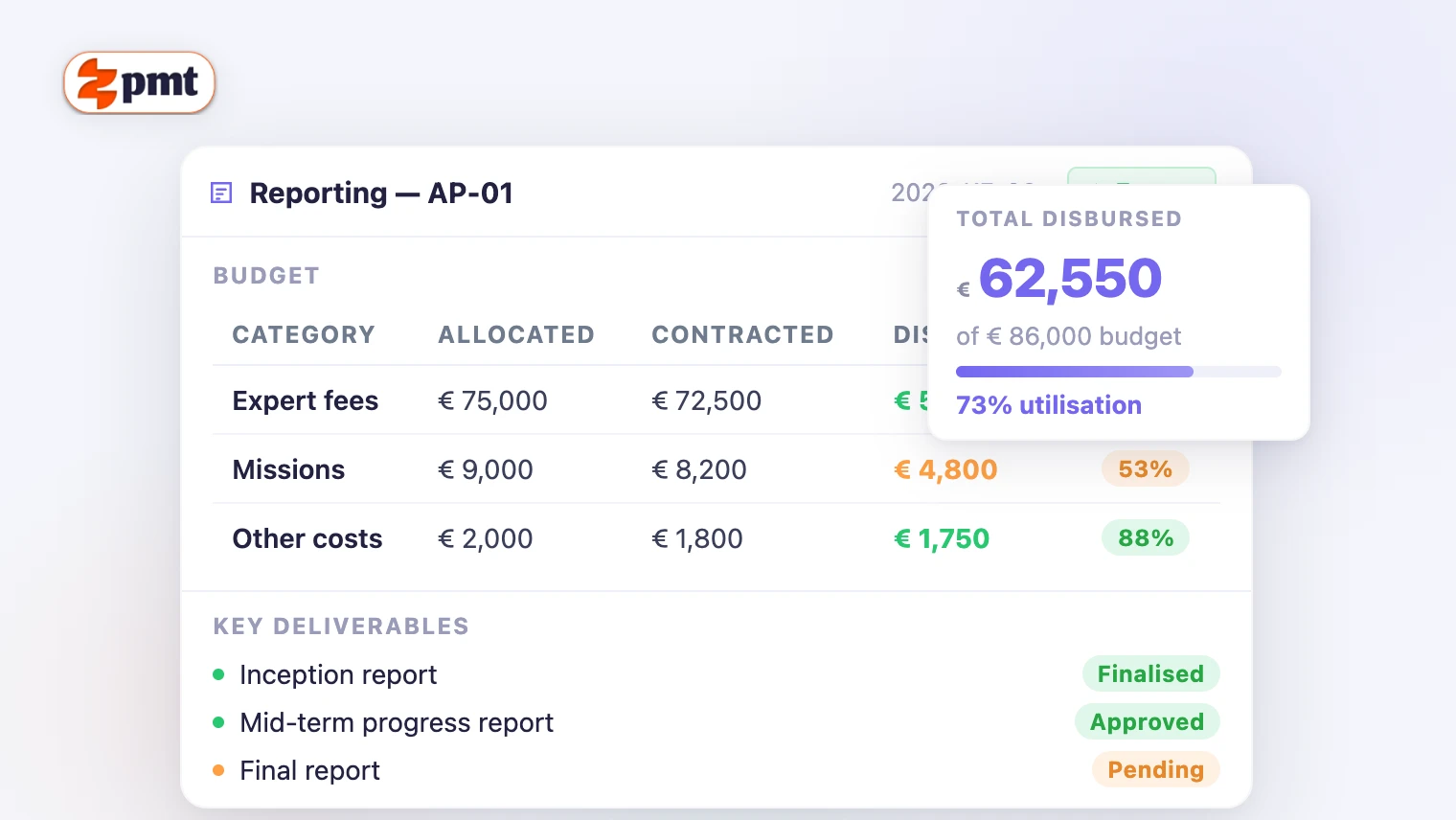
- A live portfolio view replaces reporting season. Because the connected records give you a current view of the portfolio, you can see budget execution and indicator progress on any given day, not just at the end of a cycle. Problems surface while there is still time to act on them.
- Consolidation disappears. Multi-country, multi-partner, multi-fund programmes are the hardest to report on precisely because consolidation is manual. When the data is already in one structured environment, the report reflects what the system already knows.
- Every figure is traceable. Each number in the report links back to its operational source. When a funder asks where it came from, the system answers.
From event to output
The deepest change is cultural. When reporting is a manual grind, it is an event: a deadline that pulls the team away from delivery for days at a time. When the data is structured and current, reporting becomes a natural by-product of running the programme well.
When the data is doing its job, the output is structured and export-ready, in a consistent format, with every figure traceable to the operational unit, role and date that produced it.
The bottom line
Donors are right to demand results, disaggregated and traceable. The mistake is trying to meet that demand with a reporting process bolted on after the fact. Connect indicators to live operational data, and the grind goes away, replaced by structured, traceable outputs produced as a matter of course.