
Accountability in a Technical Assistance Facility is a matter of structure, not good intentions. When public money moves across institutions, countries and funding sources, the question "who authorised this?" must have an answer that does not depend on memory, inference or trust.
In most multi-partner programmes, the answer to that question is found, when it is found at all, through archaeology: searching emails for the approval that was sent, finding the spreadsheet version that was current on the date in question, reconstructing from a chain of messages who knew what and when. That is accountability in appearance only.
What role-bound means in practice
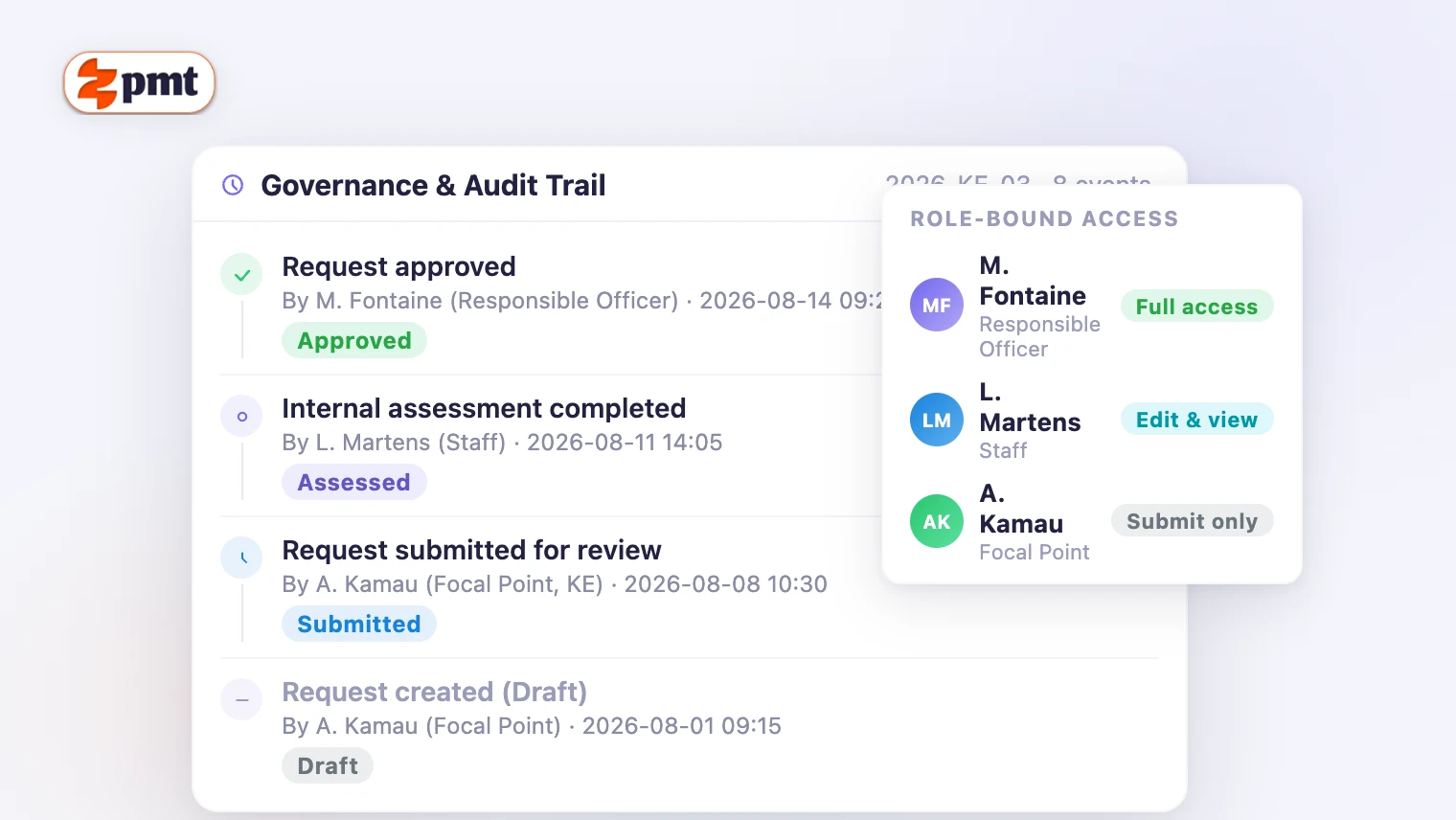
A role-bound system defines, for every action that matters, who may perform it, and enforces that definition automatically.
In a TA facility, those actions include:
- Creating a record: who may open a request, add an activity, submit an application.
- Validating a record: who may approve it, which means their name and the date are permanently attached to that approval.
- Updating a record: who may modify a budget line, change a status, amend a deliverable after the fact.
- Viewing a record: who may see sensitive data such as expert CVs, financial figures, and partner assessments.
The distinctions matter because the accountability structures of EU-funded programmes are specific. A focal point at a partner institution may submit requests but not approve them. A programme officer may validate activities but not authorise contracts above a certain value. A donor representative may have read access to results data without seeing expert personal records. These are the conditions under which institutional cooperation can be audited and trusted.
The difference between a policy and a system
Many facilities have accountability policies. Far fewer have systems that enforce them. The gap between the two is where the audit risk lives.
A policy that says "all requests must be validated by the programme director before approval" is only as reliable as the process that applies it. If validation means an email sent and a reply received, then the policy depends on someone remembering to send the email, someone else remembering to reply, and a third person remembering to check before proceeding. That chain breaks, silently, more often than anyone wants to admit.
When role-bound accountability is built into the system, and the platform will not allow a record to progress from draft to approved without a named validator having acted, the policy becomes structural. No one has to remember. The audit trail is a by-product of doing the work correctly, not a separate exercise carried out under pressure at reporting time.
What donor scrutiny actually demands
Donors requesting accountability under EU-funded programmes are asking whether every decision had an owner, a date and a documented basis, and whether the record of that decision can be produced on request.
A structured audit log, generated automatically as each action is performed, answers that question without any additional work. When the log is assembled after the fact from emails and calendar entries, it answers it badly, if at all.
The bottom line
Role-bound accountability is primarily an operational feature. The facility that enforces who may create, validate and view each record produces clean audit trails as a natural consequence of running well. The facility that relies on procedural controls (remember to cc this person, do not approve until you hear back) is exposed every time a procedure is missed. In a multi-partner programme under donor scrutiny, that exposure should be designed out, not accepted.