
The call for expertise is the hinge of the whole assistance cycle. Everything before it (the request, the approval, the action plan) is preparation. Everything after it, the delivery and the reporting, depends on getting the right expert into the right assignment. Yet in many facilities, the call is the least structured part of the entire process.
It usually looks like this: an opportunity is drafted in a document, emailed to a distribution list, and applications come back as attachments over a two-week window. Someone collates them into a spreadsheet. A shortlist is agreed in a meeting. A selection is made. And somewhere in that flow, the traceability that the rest of the facility works so hard to maintain simply drops out.
Where calls go wrong
Three failure modes come up again and again:
- Reach is invisible. Opportunities are shared by email with no record of who saw them or who responded. When a call attracts only two applicants, no one can say whether that reflects the market or a distribution list that has gone stale.
- Evaluation is undocumented. Shortlisting happens in conversation. The reasons an applicant was selected or was not live in people's heads, not in the record. That is a problem the moment a decision is questioned.
- Selection and assignment are disconnected. The chosen expert is confirmed by email, and the assignment (timeline, deliverables, mission days) is set up separately, often re-keying information that was already in the application.
These are the ordinary friction of running calls with tools that were never designed for it.
What "good" looks like
A well-run call for expertise has four properties, and a purpose-built system makes all four the default rather than the exception.
Transparent reach
Publish the call once, and let your roster come to it. When experts are subscribed and receive weekly notifications of open assignments, reach stops depending on whether someone remembered to add them to an email. Every open opportunity is visible to every relevant expert, and applications arrive through a single front door.
Structured applications
When applications are submitted against a defined structure, matched to the profile fields you already hold, you are comparing like with like. That is the precondition for fair evaluation.
Documented evaluation
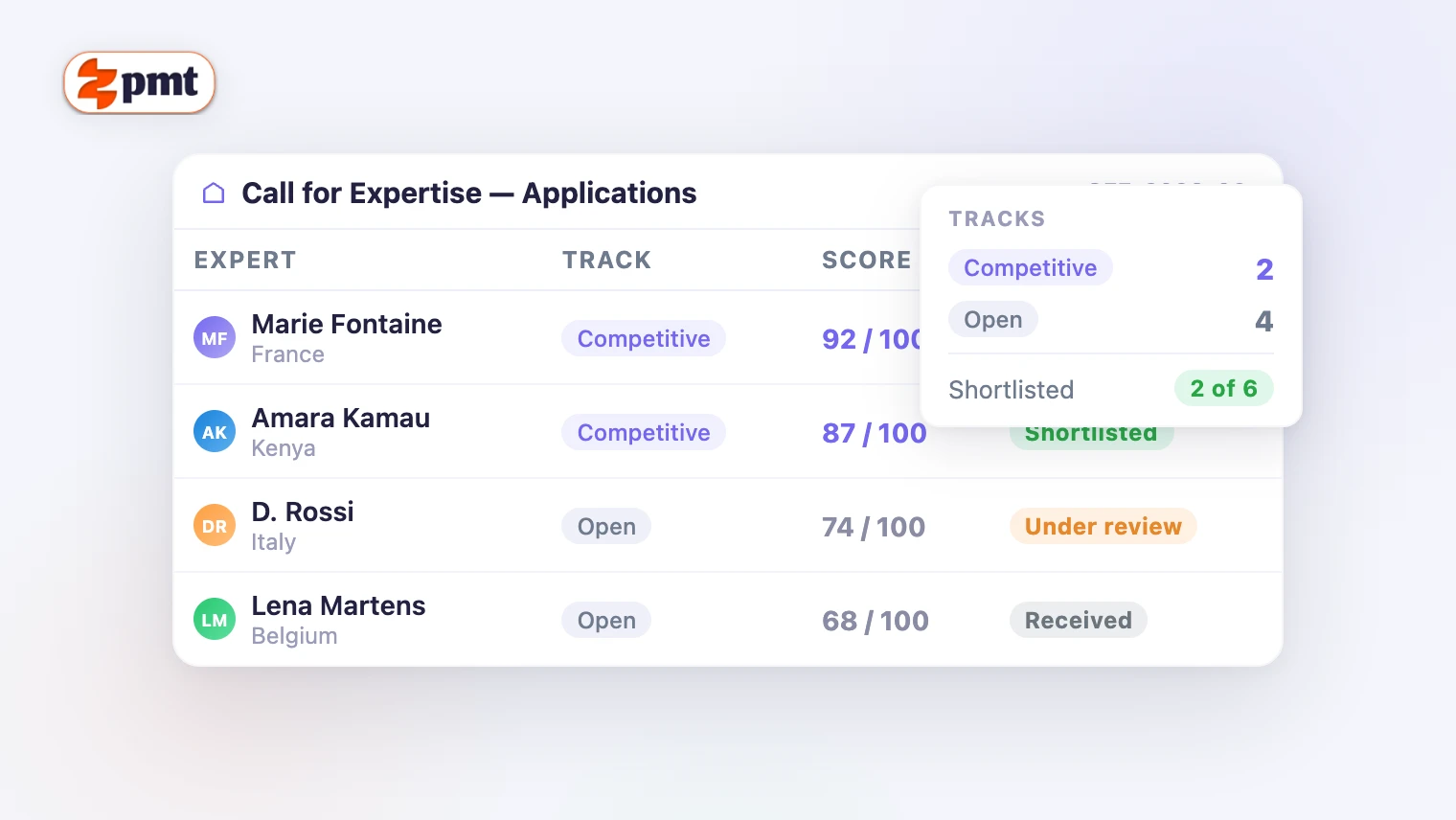
Shortlisting and scoring happen inside the system, against the criteria the call defined. The evaluation phase produces a record: who was considered, how they scored, who was shortlisted and why. That record is what turns a defensible decision into a demonstrable one.
Clean handoff to assignment
The moment an applicant is selected, the assignment should draft itself from what you already know (timeline, deliverables and reporting milestones) with nothing re-keyed. Selection and assignment are two views of the same fact.
The reusable roster is the real prize
The single biggest lever in expert mobilisation is the roster that outlives every call.
Every profile you build (education, employment history, fields of expertise, competencies, languages, references) is an asset. If it lives in a structured, connected database associated directly to activities, it works for you again and again. If it lives in a spreadsheet that is rebuilt each cycle, you are paying for the same expert twice: once to find them, and once to find them again.
The bottom line
There is no reason calls for expertise should be the chaotic middle of an otherwise orderly process. Publish once, let a subscribed roster respond, evaluate against defined criteria inside the system, and let selection flow straight into assignment. Do that, and the hinge of the assistance cycle stops squeaking and starts carrying weight.