There is a quiet overhead cost embedded in almost every Technical Assistance Facility's operations that rarely appears in any budget line: the time programme staff spend maintaining data that other people could maintain themselves.
An expert changes their contact details, updates their area of expertise, or adds a new language. A partner institution gets a new focal point. A consultant's CV is revised after a recent assignment. In most facilities, these updates arrive by email, are processed by whoever has access to the central records, and are entered manually by a programme team member who was almost certainly in the middle of something else when the message arrived.
Letting the person whose data it is update it directly sounds obvious. In practice, it requires a system architecture that most internal tools do not provide: a public-facing layer where external stakeholders can register and manage their own profiles, connected to the operational database the programme team uses, with appropriate access controls so that self-service does not become uncontrolled editing.
What the self-service layer actually covers
The external-facing layer in a TA platform serves two distinct groups.
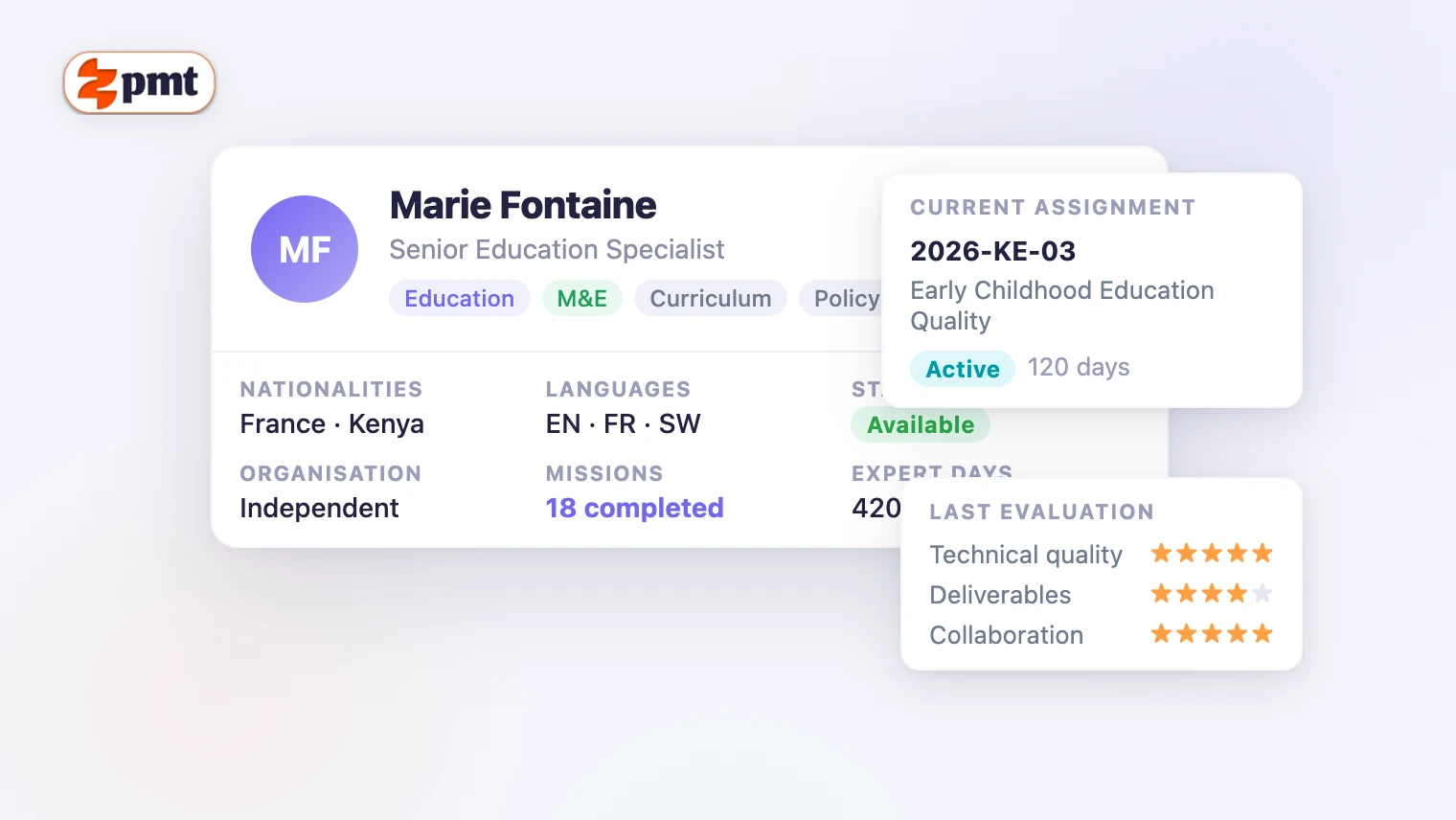
Individual experts register and maintain their own professional profiles: areas of expertise, language proficiencies, geographic experience, CVs, and availability information. When a call for expertise is published, registered experts who match the profile criteria can apply directly, submit their documentation, and track the status of their application. They do not need a programme staff member to act as intermediary.
Partner organisation focal points register their institution and maintain its details, confirm assignments linked to their organisation, and, where the facility's structure allows, submit requests for technical assistance on behalf of their institution. The request submission capability matters in particular: it shifts the entry point for new requests from the programme office to the beneficiary institution, which is both more accurate (the institution knows its own needs) and more efficient (the programme team processes requests rather than transcribing them).
Why it reduces programme-team overhead
The shift is about where the effort of keeping data current should sit.
An expert's professional profile is maintained most accurately by the expert. They know when their CV has changed, when a new assignment has added to their track record, when their availability window has shifted. Asking them to update a form is a smaller ask than asking a programme administrator to manage that information on their behalf, and the data quality is higher because the expert has a direct interest in being accurately represented when the next call is evaluated.
The same logic applies to partner focal points. The institution best placed to describe the request it is submitting is the institution submitting it. When programme staff transcribe a request from an email, they introduce an interpretation step that can distort the original intention. When the partner institution submits directly into a structured form, the record is the institution's own description, not a translation of it.
What access controls make this safe
The self-service layer works because it is controlled in two important ways.
First, self-service access is limited to the data each party owns. An expert can update their own profile but cannot see other experts' profiles or programme records. A partner focal point can submit requests and manage their institution's details but cannot access the financial or evaluation records that belong to the programme team. The access model is role-bound by design.
Second, the data that external parties enter does not automatically become validated operational data. Profiles submitted by experts are held as pending records until a programme team member confirms them. Requests submitted by partner institutions enter the request workflow at the intake stage, where they are reviewed before being approved for action planning. Self-service is an entry mechanism, not an uncontrolled write access to operational records.
The broader operational argument
A TA facility that has to act as a data entry intermediary for every external stakeholder has programme staff spending time on tasks that add no analytical value. Updating a CV or submitting a new request does not require programme knowledge; it requires a form.
Shifting those tasks to self-service redirects the programme team's time toward work that genuinely requires their knowledge: evaluating applications, approving requests, managing delivery, and interpreting the portfolio data to support management decisions.
The bottom line
The self-service layer for experts and partner focal points follows from asking seriously where effort should sit in a TA operation. Data about experts should be maintained by experts. Requests from partner institutions should be submitted by those institutions. The programme team should process, evaluate and manage, not transcribe and enter. Building the external-facing layer that makes that possible is part of what it means to design a TA platform around the actual operating model, rather than adapt one built for a different purpose.