
A Technical Assistance Facility is hard to describe to someone outside the sector. It sits somewhere between a project, a consultancy and a grant fund, with a single purpose: connecting institutions that need expertise with the experts who can provide it, in a way that is transparent, accountable and repeatable. That combination of managed expertise, governance obligations and multi-institutional scope is also what makes a facility difficult to run well.
The assistance cycle, end to end
A facility manages a full cycle, and every stage feeds the next:
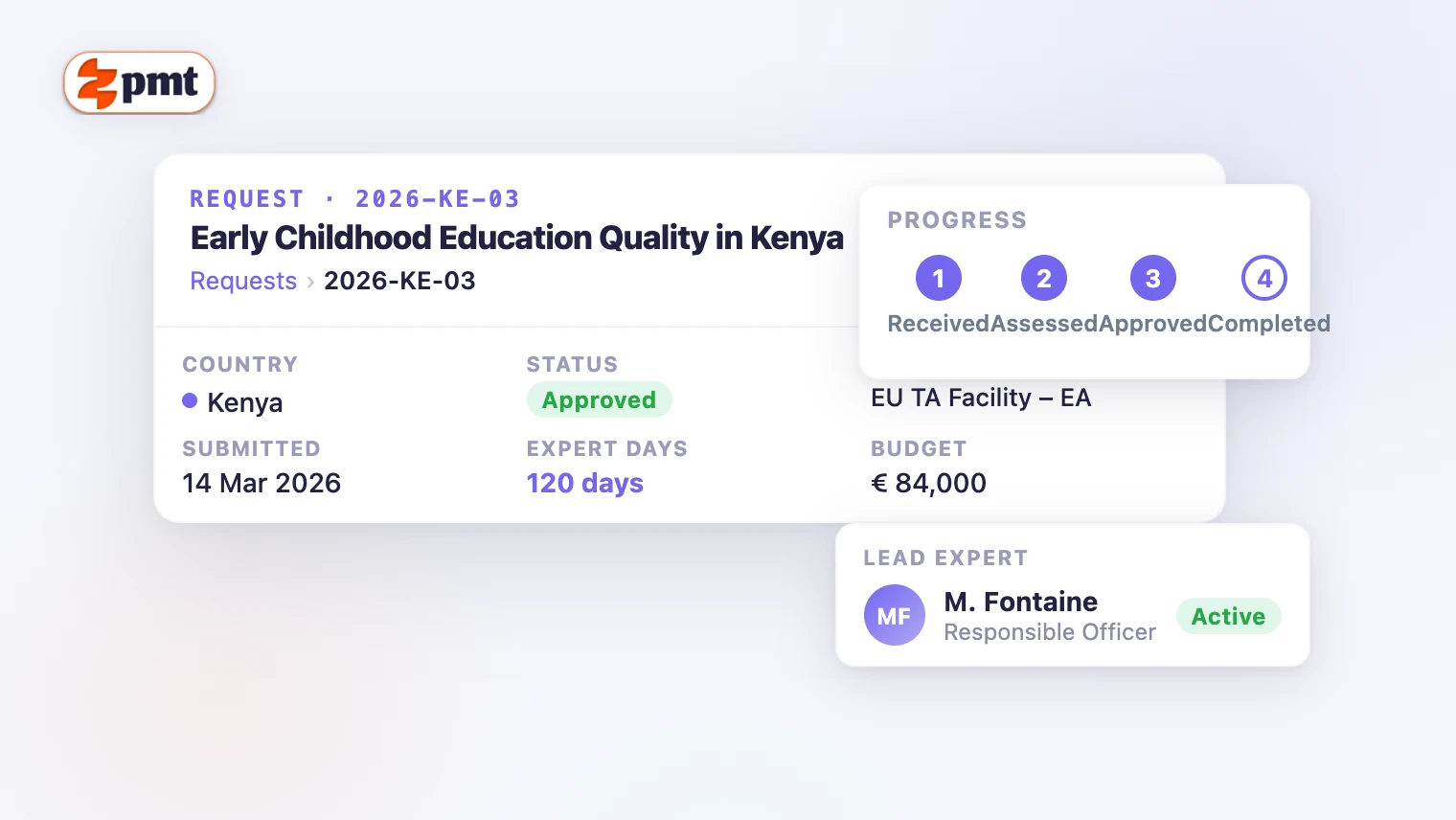
- Requests. A partner institution or government body submits a formal request for assistance, defining the expertise needed, the objectives, the expected results and the geographic scope.
- Review and approval. Internal staff evaluate the request, weigh it against available resources and priorities, and approve it, with the decision, the owner and the date recorded.
- Programming. Approved requests are linked to action plans and broken down into actions and activities with timelines and indicators.
- Mobilisation. Calls for expertise are published, experts and organisations apply, applications are evaluated, and the selected applicants are contracted.
- Delivery. Assignments are executed, with working days and mission days tracked against plan.
- Monitoring and reporting. Progress, budgets and indicators are tracked against plan, and consolidated reports go back to funders.
Each stage produces information the next stage depends on. Lose the thread anywhere, and the whole chain suffers.
Why spreadsheets break
Most facilities start with the tools everyone already has: spreadsheets for the expert roster, email for calls and applications, shared drives for documents, and a separate reporting exercise at the end of each cycle.
It works until it doesn't. The roster in one spreadsheet drifts out of sync with the assignment tracker in another. A decision made over email never makes it into the record. Reporting becomes an archaeological dig through inboxes and folders, reconstructing what happened after the fact.
The deeper problem is that none of these tools understand the relationships that define a facility: that this request became this action, which was delivered through this call, to which this expert applied and was assigned these mission days. Those links are the institutional memory. In a pile of disconnected files, they simply do not exist.
What a purpose-built platform changes
A dedicated operations platform treats the assistance cycle as one connected system rather than a series of handoffs. Requests, experts, documents and reporting live in the same place, with defined responsibilities at every stage.
Three things change immediately:
- Traceability becomes automatic. Every change, decision and approval is recorded as it happens, not reconstructed later. The audit trail is a by-product of doing the work, not a separate chore.
- Reporting draws on structured data. When indicators and budgets are connected to live operational data, a donor-ready report comes from the structured records in a fraction of the time, with every figure traceable to its source.
- Expertise becomes reusable. A structured expert roster means profiles built for one call are retained and available to reuse for the next. The facility's most valuable asset stops evaporating between cycles.
The bottom line
A Technical Assistance Facility has a specific operating model: request to result, across many institutions and countries. It deserves a system built around that model rather than adapted from generic tools after the fact.
That is the gap ZeePMT was built to close. If you run a facility on spreadsheets and email today, the more interesting question is how much traceability, reusable expertise and reporting time you are leaving on the table.