
The unit of account in a Technical Assistance Facility is the day. Working days and mission days are how expertise is contracted, how budgets are consumed, how delivery is measured, and how results are reported back to donors. Everything else in the operational record points to them eventually.
Yet in many facilities, working and mission days are tracked in a way that is barely adequate for payroll, let alone programme management. A spreadsheet updated by whomever remembers to update it, reconciled at the end of a cycle in a scramble that everyone dreads. The numbers arrive at reporting time carrying uncertainty that cannot be resolved without going back through emails and calendars.
The distinction that matters
Working days and mission days are related but not the same, and the distinction matters for both operations and reporting.
A working day is a day of input: time spent by an expert delivering against an assignment, typically calculated at a daily rate and linked to a contract. A mission day is a day of presence: a day spent in the field, at the partner's location, which may carry additional costs (per diem, travel) and which is often the unit that partner institutions track as the tangible sign of cooperation received.
In peer-to-peer cooperation, mission days carry particular weight. The providing institution is lending real capacity from a public body, and the receiving institution measures what it got in days of expert presence. Getting those numbers right produces the factual record of what the cooperation delivered.
Planned, contracted and actual
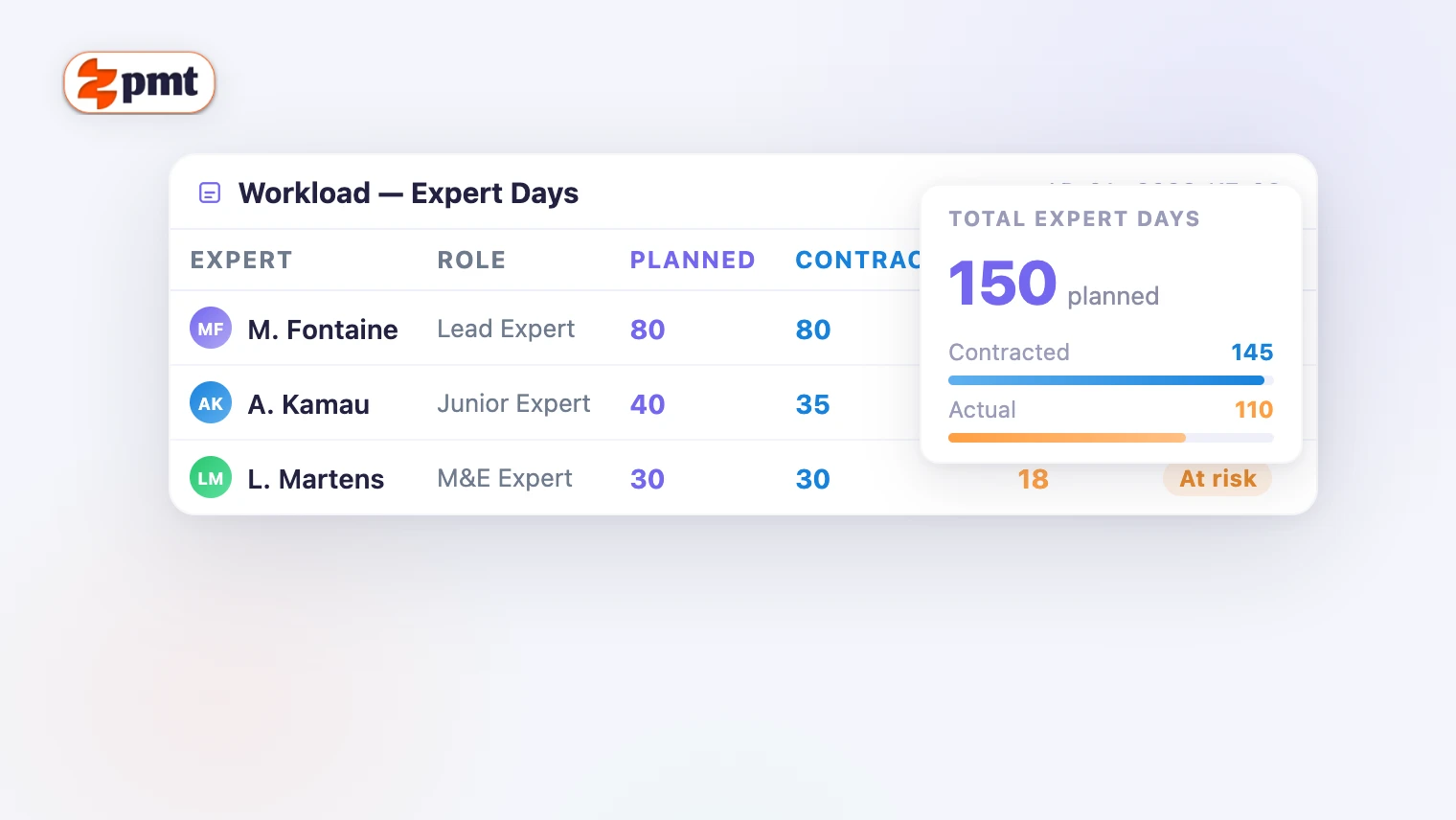
Three figures need to be tracked for every assignment, and they are rarely identical: planned days (what the action plan specified), contracted days (what was agreed with the expert, which may differ from the plan if scope shifted during selection), and actual days (what was delivered and logged).
The gap between planned and contracted tells you something about programming quality. The gap between contracted and actual tells you something about delivery performance. Both gaps have budget implications, and both are relevant to the indicators that feed into donor reports.
When all three figures live in the same system, the programme manager can check them throughout the cycle rather than waiting for reporting season. When they live in separate spreadsheets, the comparison happens once, under pressure, with figures that may not reconcile because they were entered by different people against different templates.
Why the activity level is the right home
The instinct is to track working days at programme or contract level: aggregate figures that give an overall picture. The problem is that aggregate figures cannot answer the questions that matter most: which activity consumed the budget, which expert delivered against which result, what was the cost per output.
When working days are recorded at the activity level, attached to the specific activity that generated the assignment, the aggregation upward is automatic. Programme-level totals are the sum of activity-level records, not a separate entry. And the drill-down path from the programme figure to the individual day is always available, which is exactly what a detailed audit requires.
The bottom line
Working days and mission days are the financial record of delivery: the evidence that public money produced real cooperation days against specific activities, by specific experts, under specific contracts. Tracked at activity level in a connected system, they give programme managers a reliable source for reporting, budgeting and audit at any point in the cycle. In a spreadsheet updated by memory and reconciled at year-end, they arrive at reporting time carrying uncertainty the team cannot resolve without going back through emails and calendars.